AstroGenesis

Beta

accelerating astrophysical research

A multi-agent platform integrating multi-wavelength and multi-messenger data, physical modeling, and literature reasoning into a unified research workflow.

One question, a finished analysis

Real answers to the four example questions above: cited literature, retrieved data, fitted models.

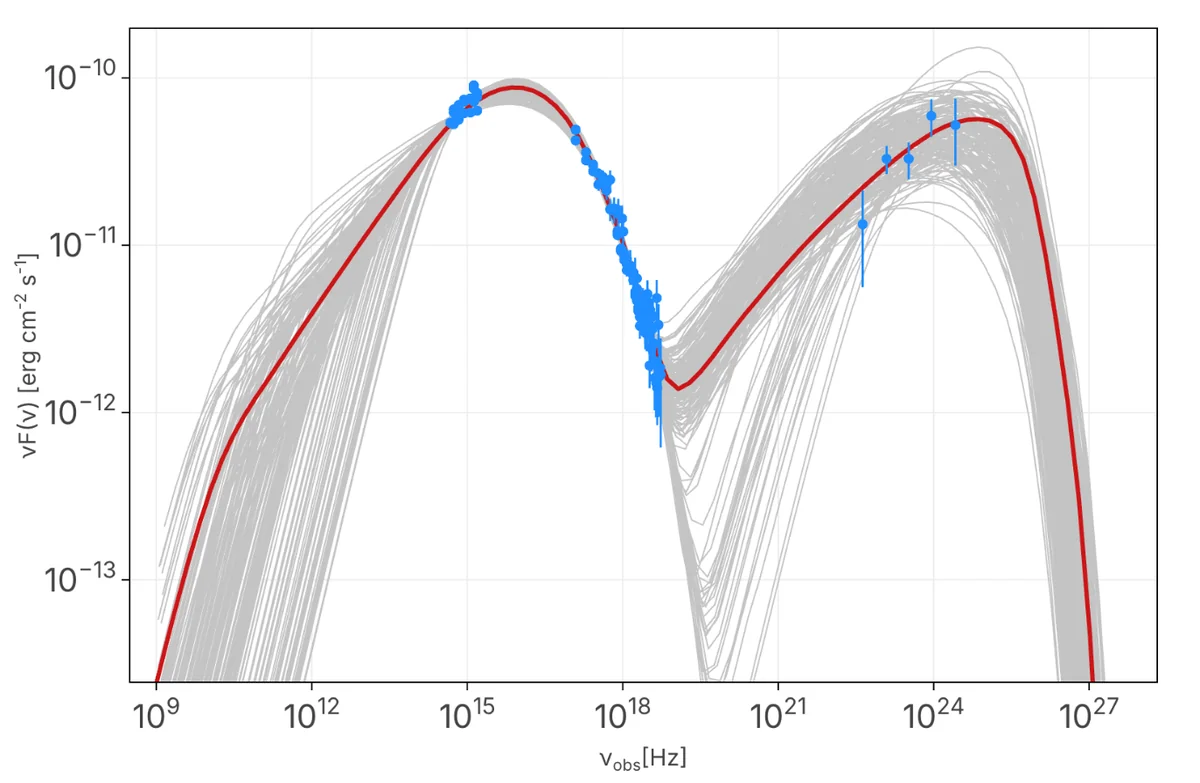
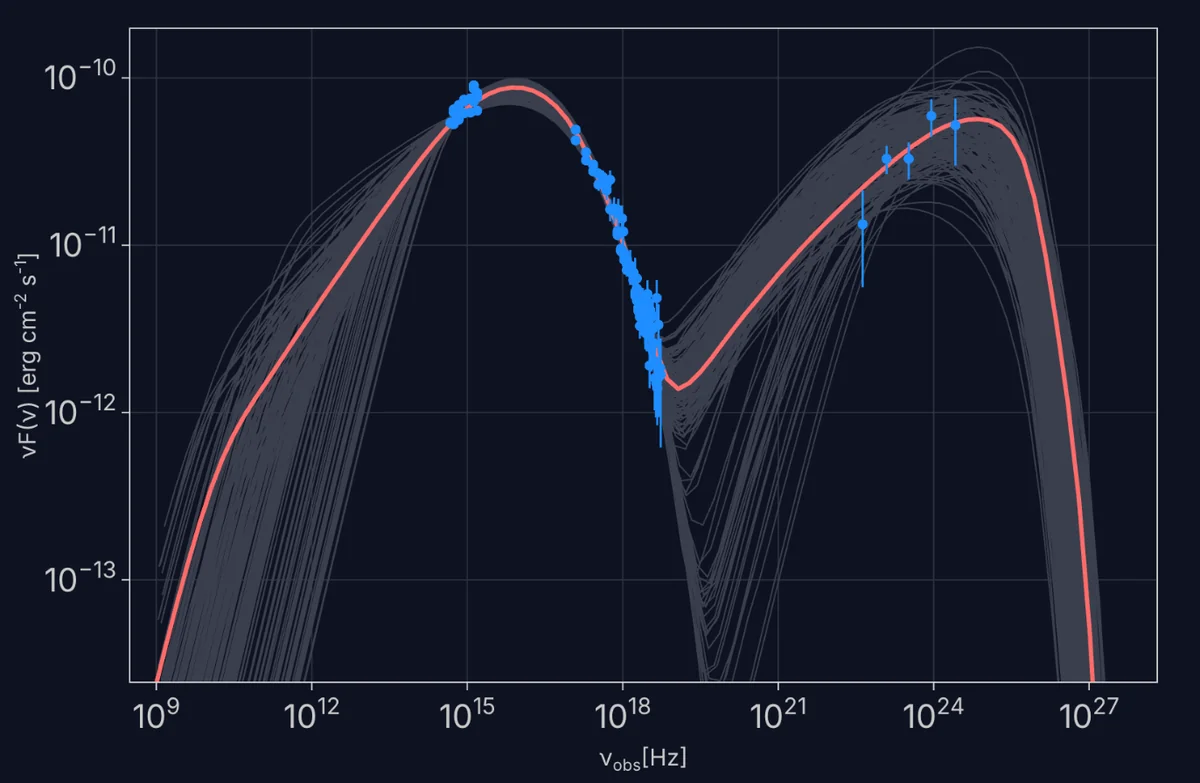
QuestionFit a one-zone SSC model to the SED of PKS 2155-304 observed between 9 and 23 August 2013

Homogeneous one-zone SSC, z = 0.116, EBL absorption included, 141 points. Best fit:

Doppler factor δ
23.0 ± 5.2
Magnetic field B
≈ 29 mG
Region size R
≈ 1.6×1017 cm
Electron index p
2.12 ± 0.22

Fermi-LAT, NuSTAR, Swift XRT and UVOT, and SMARTS data, all within 9–23 August 2013.

PKS 2155-304 · one-zone SSC fitdata · best fit · samples
Spectral energy distribution of PKS 2155-304, 9–23 August 2013, with the one-zone SSC best fit and posterior samples
PlotPDF reportBest-fit CSV

The Research Agents

Literature Analysis

Gathers and cross-references astrophysical publications for a specific question, extracting methods and assumptions and showing where studies agree or differ.

“Where do gamma rays originate in the jet of 3C 279 during flares, and what evidence supports different emission scenarios?”

Data Retrieval

Retrieves multi-wavelength and multi-messenger data from science-ready archives, then runs temporal and spectral analyses to build broadband datasets for modeling.

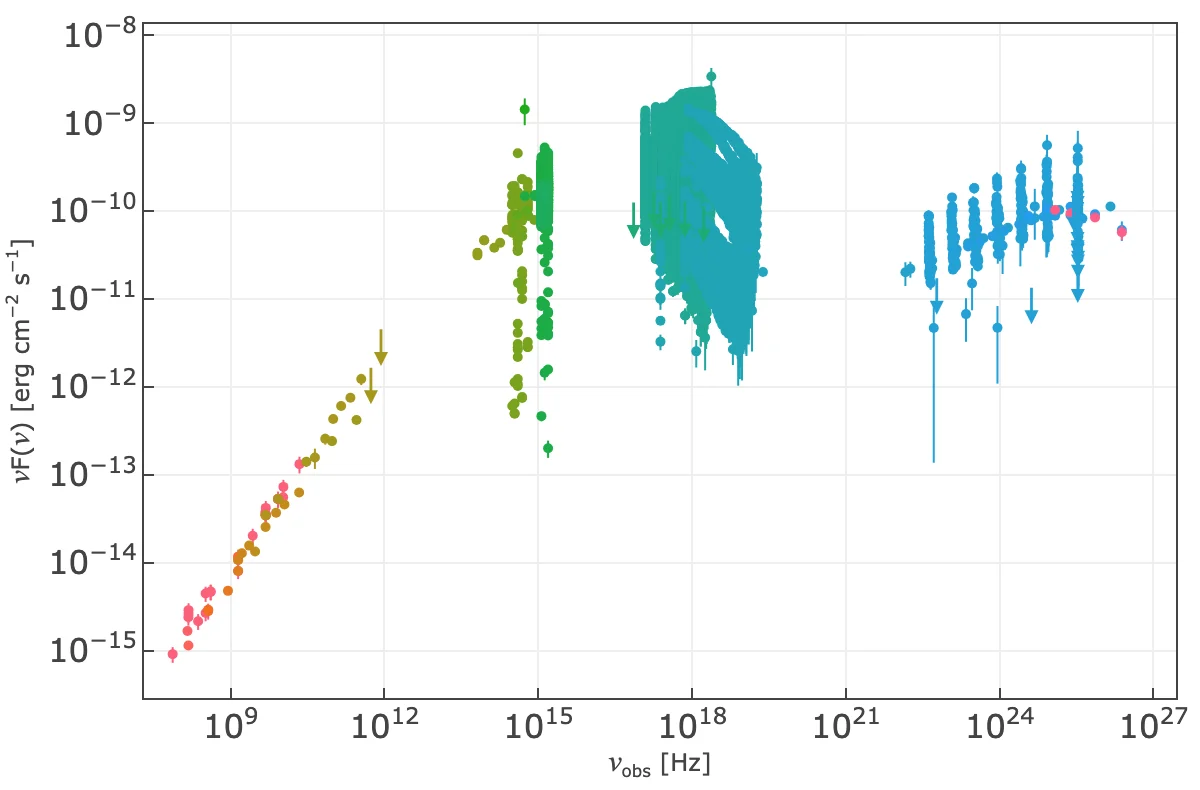
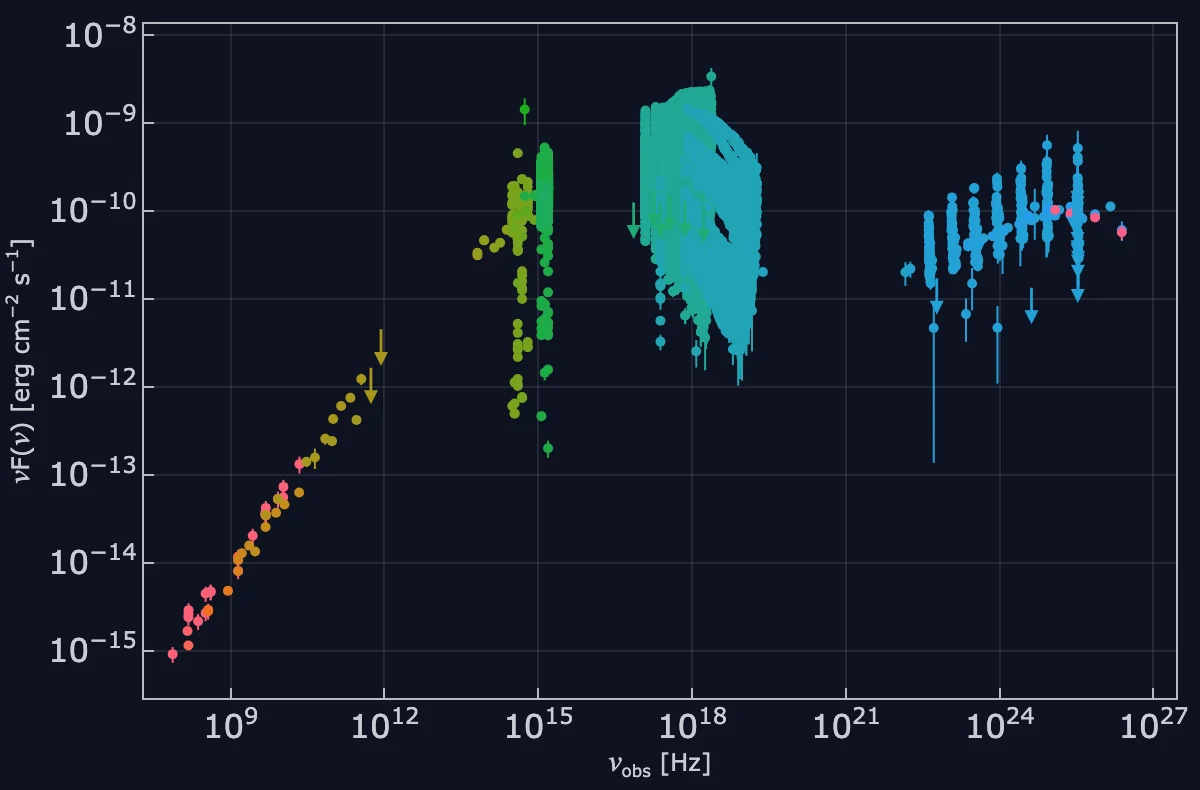
“Retrieve multi-epoch spectral energy distributions of Mrk 421 from 2009 to 2015”

Physical Modeling

Evaluates theoretical emission models against observations with neural networks trained on radiative simulations, for fast parameter estimation and model comparison.

“Fit a one-zone SSC model to the SED of PKS 2155-304 observed between 9 and 23 August 2013”

Research Ideation

Combines observational data and the literature to surface patterns, tensions and open issues worth investigating with existing data and models.

“What remains open in the association of IceCube-170922A with TXS 0506+056?”

Published and measured

Paper · arXiv:2609.28579 [astro-ph.IM]

AstroGenesis: A Domain-Specific Multi-Agent AI for Astrophysical Research

N. Sahakyan et al.

Benchmark · blazar literature retrieval, Hit@5

A relevant paper in the top five, about 4 times in 5

Single-paper questions (209)76.6%
Multi-paper questions (154)79.2%

Share of questions with at least one relevant paper in the top five results: 209 single-paper and 154 multi-paper questions over ~21,000 blazar papers (arXiv:2609.28579, Table 1).

Research Queries

Frequently asked questions.

AstroGenesis currently retrieves observational data through access to the Markarian Multiwavelength Data Center (MMDC), which provides science-ready, curated multi-wavelength and multi-messenger datasets. The retrieval process preserves metadata related to instrument, time coverage, and observational context. The system is designed in a modular way, allowing additional data centers and archives to be connected through API-based interfaces, enabling data retrieval from any compatible external repository as support is added.

AstroGenesis uses neural networks that are trained on large sets of numerical simulations generated with physically motivated radiative codes. These simulations define the behavior of the underlying theoretical models across relevant parameter spaces. Once trained, the neural networks reproduce the results of the numerical simulations with high accuracy while enabling much faster evaluation, supporting efficient parameter estimation, model comparison, and exploration of physically motivated scenarios.

AstroGenesis is designed to integrate observational datasets and theoretical models that are applicable to a specific class of astrophysical sources, rather than to individual objects or multiple unrelated classes. Multi-wavelength and multi-messenger datasets can be connected when they describe source populations in a structured, programmatic form. Likewise, theoretical models can be integrated when they are well tested, physically motivated, and formulated for a single source class, allowing consistent application and interpretation within the AstroGenesis framework.

At present, AstroGenesis operates on science-ready observational data products rather than raw instrumental data. Analysis pipelines for raw observational data are currently under development and integration. As these pipelines are implemented, AstroGenesis is designed to progressively support the analysis of raw data, enabling end-to-end workflows from initial data products to scientific interpretation in future releases.

Still have questions?

Speak directly with the developers.

Contact Research Support

Start with your own source

Ask in plain language: literature, data, or a model fit.

Try it free

Free plan: 10 messages per day